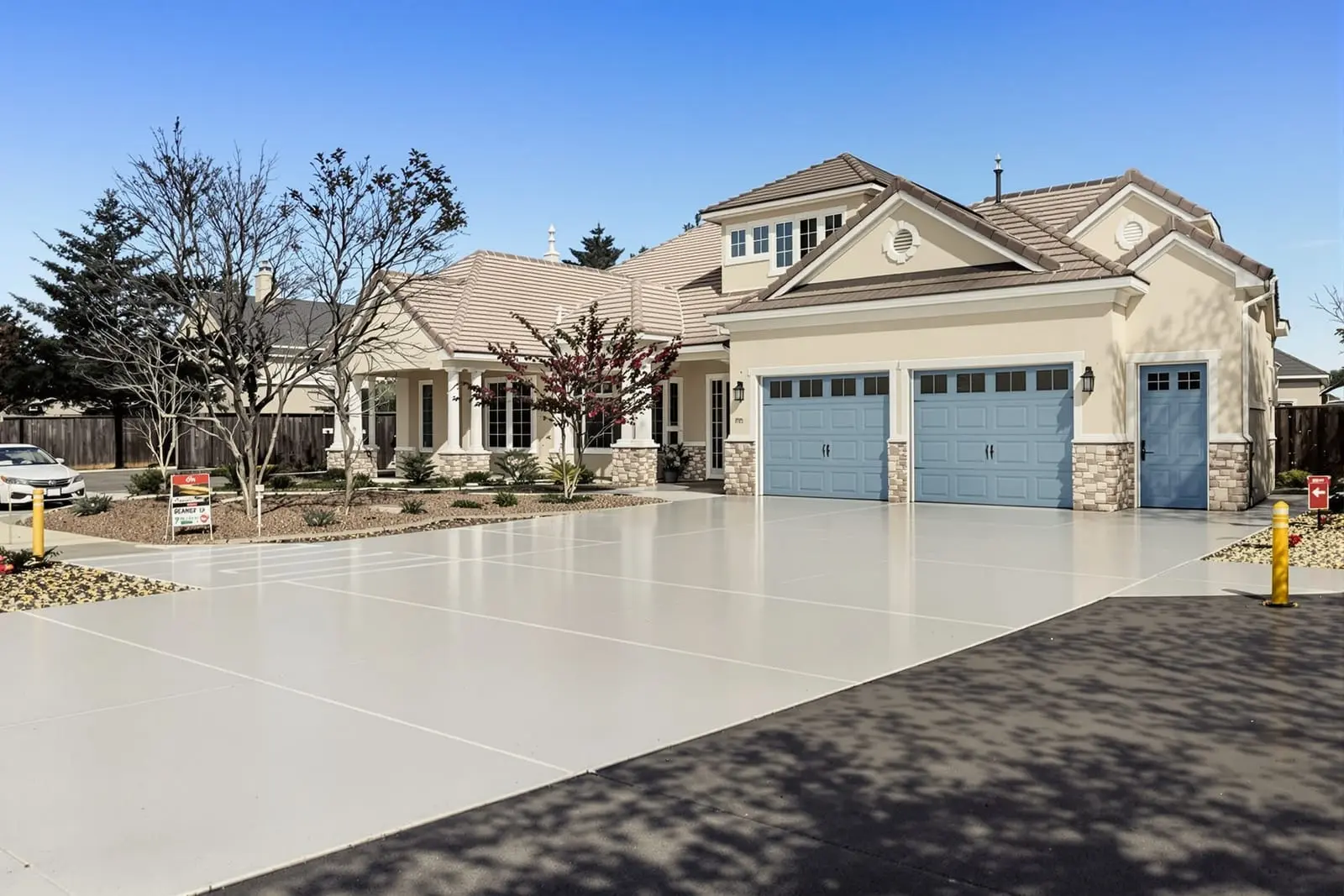
Our commercial concrete paving in Little Rock, AR supports businesses, retail centers, and multifamily properties. We install drives, parking areas, and walkways that handle constant traffic. From layout and grading to reinforcement and finishing, we manage projects efficiently to reduce downtime. Request a competitive bid for your next commercial paving job.
Primetime Concrete Little Rock provides professional commercial concrete paving throughout Little Rock, AR and the surrounding area. Our licensed, insured crew delivers safe, clean, on-time work with a free estimate before anything begins. Call (501) 441-4583 or request your free quote.
Commercial Concrete Paving for Little Rock Businesses
Commercial concrete paving is not just a thicker driveway. For a business in Little Rock it is a structural surface that has to handle delivery trucks, customers, and our mix of hot summers and freeze-thaw cycles. Primetime Concrete Little Rock focuses on building parking lots, access roads, loading areas, dumpster pads, and drive lanes that hold up under real daily use, not just look good on opening day.
When we plan a commercial concrete paving project, we start by looking at how your site is actually used. A medical office with light car traffic needs a different pavement design than a distribution warehouse with daily 18 wheelers. We look at truck routes, turning areas, slopes, and drainage patterns on your property. This is what drives decisions on slab thickness, concrete strength, and reinforcement, which is where most of the true cost and durability of the job are decided.
Little Rock weather matters too. Our hot, sunny summers can cause surface drying and cracking if the mix or curing is wrong, and winter cold snaps can push moisture into any weak spots. Primetime Concrete Little Rock adjusts mix designs and placement timing to local conditions so your pavement does not start scaling or raveling after just a couple of seasons.
How We Design and Build Commercial Concrete Pavement
A solid commercial pavement starts with an accurate layout and elevations. Our crew sets control lines and grades so that water moves away from your building entries and does not stand in wheel paths. For new construction we coordinate with your civil plans. For replacements or expansions we shoot existing grades and often adjust them slightly to improve drainage and ADA access.
Subgrade and base work is where many commercial concrete paving jobs fail. We strip out soft topsoil and organics, then proof roll the subgrade to find any pumping or weak spots. In the clay-heavy soils common around Little Rock we often undercut soft pockets and bring in crushed aggregate, then compact it in thin lifts with vibratory rollers. This creates a uniform base that supports the slab and prevents random cracking and settlement.
Once the base is set, we build concrete forms or use string lines for larger pours. For most commercial parking and drive lanes in Little Rock we pour 4 to 7 inch slabs for cars and light trucks, and 7 to 10 inches in loading zones and truck routes, depending on your traffic and budget. Primetime Concrete Little Rock typically uses 4000 to 5000 PSI concrete with air entrainment for freeze-thaw resistance, and we often add fiber reinforcement or rebar mats where loads are higher or the subgrade is variable.
We place the concrete using chutes or pumps, then strike it off, bull float, and finish according to use. For most commercial lots we recommend a broom finish with good texture so customers are not slipping in the rain. In loading areas and steep drives we may increase texture. We cut or saw control joints on a tight pattern to guide where the concrete cracks, and we seal joints where needed to keep water and deicing chemicals out of the base.
Options, Site Constraints, and What Drives Cost
Commercial concrete paving cost in Little Rock is mainly driven by four things: thickness, reinforcement, site conditions, and access. Thickness and reinforcement are tied directly to how many vehicles, how heavy they are, and where they travel. A restaurant with mostly cars and a few box trucks can often use a thinner section in most of the lot and a thicker band along delivery routes. A freight or industrial facility may need heavy duty thickness everywhere. Primetime Concrete Little Rock walks you through where spending extra on thickness will truly matter and where you can safely save.
Site conditions often add or reduce cost. If your existing pavement is failing because of poor base or bad drainage, we may recommend more aggressive removal, undercutting, and new base stone. This costs more up front but prevents you from paying twice when a thin overlay fails. Tight sites in downtown Little Rock, limited access around existing buildings, and night or weekend work requirements for retail centers also affect price because they control how quickly we can move concrete trucks in and out and how large each pour can be.
You also have options on appearance and performance. Standard gray broom finish is the most cost effective and practical. For higher visibility storefronts, hotel entries, or walkways we can add integral color, decorative borders, or light exposed aggregate, while still keeping the heavy traffic lanes as standard structural pavement. We can also slope and grade for future EV charging spots and plan thicker aprons at dumpster pads where garbage trucks turn sharply, which is a common failure point when these zones are not designed separately.
Timing the project matters. Many Little Rock businesses prefer phased work so parts of the lot stay open. This can add some joint lines and setup time, but it often keeps your doors open and your revenue flowing, which is usually worth more than the extra concrete joints.
Dealing With Common Problems in Existing Commercial Pavement
Most commercial concrete paving projects we handle in Little Rock are not blank slates. Often we are replacing patched asphalt, broken concrete panels, or failed loading areas. The visible cracks are usually symptoms of deeper issues like thin sections, bad drainage, or poor base preparation. Primetime Concrete Little Rock spends time diagnosing what went wrong so we do not repeat the same mistake with new concrete.
Frequent issues we see include cracked panels along truck paths, settled slabs around catch basins, and potholes or pumping in front of loading docks. In many cases water has been running across or under the pavement, softening the base. To fix this correctly we may rework inlets, adjust slopes, and install additional drainage structures or edge drains so water has a controlled path away from the pavement.
Thermal and shrinkage cracking is another concern in our climate. Wide, random cracking often means joints were spaced too far apart, the slab was too thin, or the base moved. We correct this by using closer joint spacing, stronger mix designs, and consistent compaction. For existing facilities that cannot shut down for long, we can stage panel replacements so we remove and replace specific failed sections at a time, keeping traffic moving through the rest of the site.
Surface issues like scaling, pop outs, or slick finishes show up a lot where earlier crews poured in extreme heat or finished with too much water at the surface. In Little Rock summers we schedule pours for early morning or evening when needed, use proper curing compounds or wet curing, and keep finishing practices tight so the top layer has the same strength as the rest of the slab. This approach extends the life of the pavement and reduces future maintenance costs.
What Little Rock Owners Should Know Before Hiring
Before you sign with any contractor for commercial concrete paving, ask for more than just a square foot price. You should see proposed slab thicknesses for different areas, concrete strength (PSI), reinforcement type, joint spacing, base thickness, and how drainage is being handled. Primetime Concrete Little Rock includes these details in writing so you are not comparing a light duty design to a heavy duty design without realizing it.
Check that your contractor understands local codes and ADA requirements for slopes, cross slopes, and accessible routes. Misplaced ramps or steep cross slopes in parking stalls can trigger expensive rework later or problems with inspections. We routinely coordinate with city requirements and can adjust grades so your project passes without headaches.
Ask about traffic control and business access during the job. A thoughtful phasing plan can keep your main entrances open or at least stagger closures so customers and employees always have a way in. We use clear signage, cones, and barricades to separate work areas from active traffic, and we plan cure times for high traffic areas so you are not putting vehicles on green concrete.
Finally, consider the long term. A slightly higher up front cost for thicker pavement in truck routes, better base preparation, and proper jointing often saves you major money over ten or fifteen years. Primetime Concrete Little Rock is happy to walk your site, mark out heavy load zones, and give you a realistic picture of where it is worth upgrading and where standard details are perfectly fine. That way your commercial concrete paving supports your business instead of becoming a recurring repair line on your budget.
“
Professional commercial concrete paving, done right the first time, quality materials, honest pricing, and results that last.
Primetime Concrete Little Rock
Commercial Concrete Paving Across Our Service Area