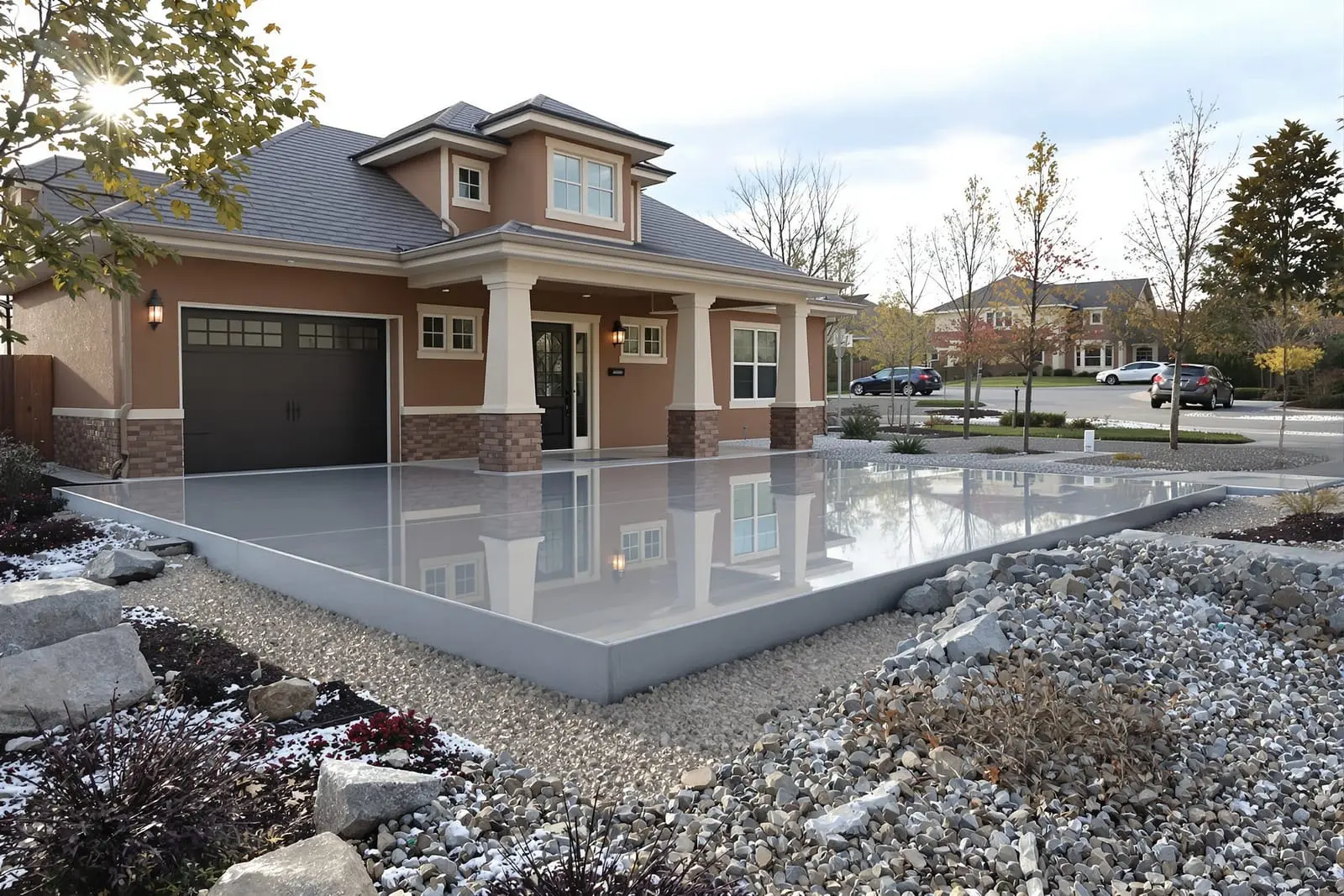
We pour commercial concrete flatwork in Little Rock, AR for building floors, trash pads, machine pads, and exterior hardscapes. Our crews are experienced with large pours, reinforcement, and finishing to specified tolerances. Expansion and control joints are placed correctly to help control cracking. Request pricing for your upcoming slab or flatwork project.
Primetime Concrete Little Rock provides professional commercial concrete flatwork throughout Little Rock, AR and the surrounding area. Our licensed, insured crew delivers safe, clean, on-time work with a free estimate before anything begins. Call (501) 441-4583 or request your free quote.
Commercial concrete flatwork built for Little Rock businesses
Commercial concrete flatwork is the working surface of your business. Parking areas, loading zones, dumpster pads, walkways, equipment slabs, and warehouse floors all fall into this category. When they fail, you feel it in safety issues, drainage problems, and downtime. At Primetime Concrete Little Rock, we focus on flatwork that holds up to daily commercial use and Arkansas weather.
In Little Rock, a typical commercial project might be a new slab behind a restaurant on Rodney Parham, a forklift rated floor in a Southwest Little Rock warehouse, or a drive lane at a medical office in West Little Rock. Each of these needs a different slab thickness, reinforcement pattern, and finish. We start by walking the site with you, discussing how the area will actually be used, then matching that to the right flatwork design so you are not paying for unnecessary concrete, but you are not under building a surface that will crack or rut in a year.
Our goal is to give owners, facility managers, and general contractors a clear picture of what is involved so there are no surprises later. That includes talking honestly about subsurface conditions, drainage, and access. If we think heavy trucks or poor soil could be an issue, you will hear that up front along with practical options to address it.
How we design and build commercial slabs and flatwork
A strong commercial slab in Little Rock starts with the ground under it. Many sites here have a mix of clay and fill soil. We begin by proof rolling or probing the subgrade to see how it reacts under load. Soft or pumping areas are either undercut and replaced with compacted base material or stabilized so they will not cause slab failures later.
Once the subgrade is stable, we typically install a base layer of compacted crushed stone or gravel. This base improves drainage, reduces frost movement, and creates a more consistent support under the slab. On interior slabs or high tolerance surfaces, we often place a vapor barrier above the base to protect flooring adhesives and equipment from moisture coming through the concrete.
Reinforcement comes next. For most commercial flatwork, we use rebar grids or welded wire mesh, and on higher load areas, we may add dowels at construction joints or thicken the slab edges. Thickness is driven by use. Light duty walkways and patios may be 4 inches, whereas dumpster pads, drive lanes, and loading docks are commonly 6 to 8 inches or more depending on truck traffic and point loads.
We then set up forms to define the slab edges, check elevations carefully to match existing pavements, doors, or dock heights, and plan slopes for drainage. In Little Rock, a small mistake in slope shows up quickly during our heavy rains, so we are careful to provide enough pitch to move water without creating trip hazards or issues for rolling carts and pallet jacks.
During the pour, we control placement rates to allow proper consolidation and finishing. We use mechanical screeds where access allows, then bull float, edge, and joint the slab according to the design. Proper timing is critical. Finishing too early can trap bleed water and weaken the surface, which is why an experienced finishing crew is key for commercial work.
Finish options and performance upgrades for busy facilities
Commercial concrete flatwork is not one size fits all. Primetime Concrete Little Rock offers a range of finishes and mix options so your slab does what you need it to do, not just look gray.
For exterior sidewalks and entries, broom finishes are popular because they provide traction when it rains. We can adjust the broom texture from light to coarse depending on your preference and the footwear your customers typically wear. Around hospitals and office parks where appearance matters, we can add decorative borders, integral color, or exposed aggregate sections for a more architectural look while still keeping the surface practical and slip resistant.
Inside warehouses, shops, and retail spaces, many clients want a hard troweled finish for smooth rolling of lifts and pallet jacks. For heavier industrial use around the port, rail spurs, or manufacturing areas, we can specify higher strength mixes, fiber reinforcement, and surface hardeners that resist abrasion from steel wheels and frequent traffic.
We also look at long term maintenance. If you are planning to seal or polish interior slabs later, we adjust the mix and finishing process so the surface will respond well to those treatments. On exterior flatwork that sees deicing salts, we recommend air entrained mixes and penetrating sealers to resist freeze and thaw cycles, which are a regular factor in central Arkansas winters.
Joint layout is another performance upgrade that is often overlooked. Proper joint spacing and depth controls where cracks will occur. We plan the joint pattern around doorways, columns, and island layouts so the slab both looks orderly and moves as intended over time.
Costs, timelines, and what drives your investment
Commercial concrete flatwork costs in Little Rock depend on more than just square footage. When Primetime Concrete Little Rock prices a slab or pavement project, we look at use, access, subgrade conditions, and schedule as the main drivers.
Use and load determine slab thickness, reinforcement, and mix design. A basic sidewalk for a small retail strip might use a standard 4 inch slab with light reinforcement. A trash truck access lane or warehouse loading zone may require deeper sections, doweled joints, and higher strength concrete, all of which add material and labor cost but prevent costly failures later.
Access and site logistics are another big factor. If we can reach the pour area directly with concrete trucks, costs are typically lower. When we need pump trucks, buggying, or staged pours around tight downtown sites or operating businesses, the labor and equipment needs increase. Night or off hour work to avoid impacting store hours or hospital traffic can also affect pricing, although it often pays for itself in reduced disruption.
Subgrade conditions under your existing pavement or in new construction areas can change both scope and cost. If we find undocumented fill, old foundations, or saturated soils during preparation, we will show you what we see and discuss options such as undercutting, stabilization, or thicker base layers. Handling these issues correctly at the start prevents heaving, settlement, and slab break up later.
As for timelines, a straightforward flatwork job may take a day or two to form and pour, plus curing time before full use. For heavy use slabs, we usually recommend at least 7 days before truck traffic and 28 days for full design strength. We will walk you through a realistic schedule so you can plan around the work, including any phased construction needed to keep your business accessible.
Common Little Rock issues and how we prevent them
Our team has rebuilt plenty of failed commercial slabs in Little Rock, which means we know the common local problems and how to avoid them.
One frequent issue is cracking from inadequate joints or poor base support. We combat this by carefully spacing control joints, cutting them at the right time and depth, and making sure the base is uniformly compacted. We also focus on consistent curing, which reduces shrinkage cracks and surface checking.
Drainage problems are another headache for businesses, especially with Arkansas thunderstorms. Water that pools near entries, doors, or dock pits leads to slick spots, icing in winter, and even interior water intrusion. When we design commercial concrete flatwork, we check existing elevations, gutter locations, and downspout discharges, then build in slopes and transitions that move water away from the building. Where necessary, we coordinate with your plumber or site contractor to add drains or rework problem areas.
Freeze and thaw damage, particularly at parking lot transitions and exposed slab edges, shows up as spalling and surface scaling. We specify appropriate mixes and curing practices for our climate, and strongly encourage sealing high exposure surfaces. If your facility uses deicers regularly, we will discuss realistic maintenance expectations so the slab holds up as long as possible.
Finally, we know that keeping your doors open matters more than anything. For active businesses, we plan staging so customer entrances, fire lanes, or dock access are maintained where possible. That might mean splitting a large project into phases or scheduling critical pours during slower hours. When you hire Primetime Concrete Little Rock, you get a commercial crew that understands both the concrete and the operational needs of a working property.
“
Professional commercial slabs & flatwork, done right the first time, quality materials, honest pricing, and results that last.
Primetime Concrete Little Rock
Commercial Slabs & Flatwork Across Our Service Area