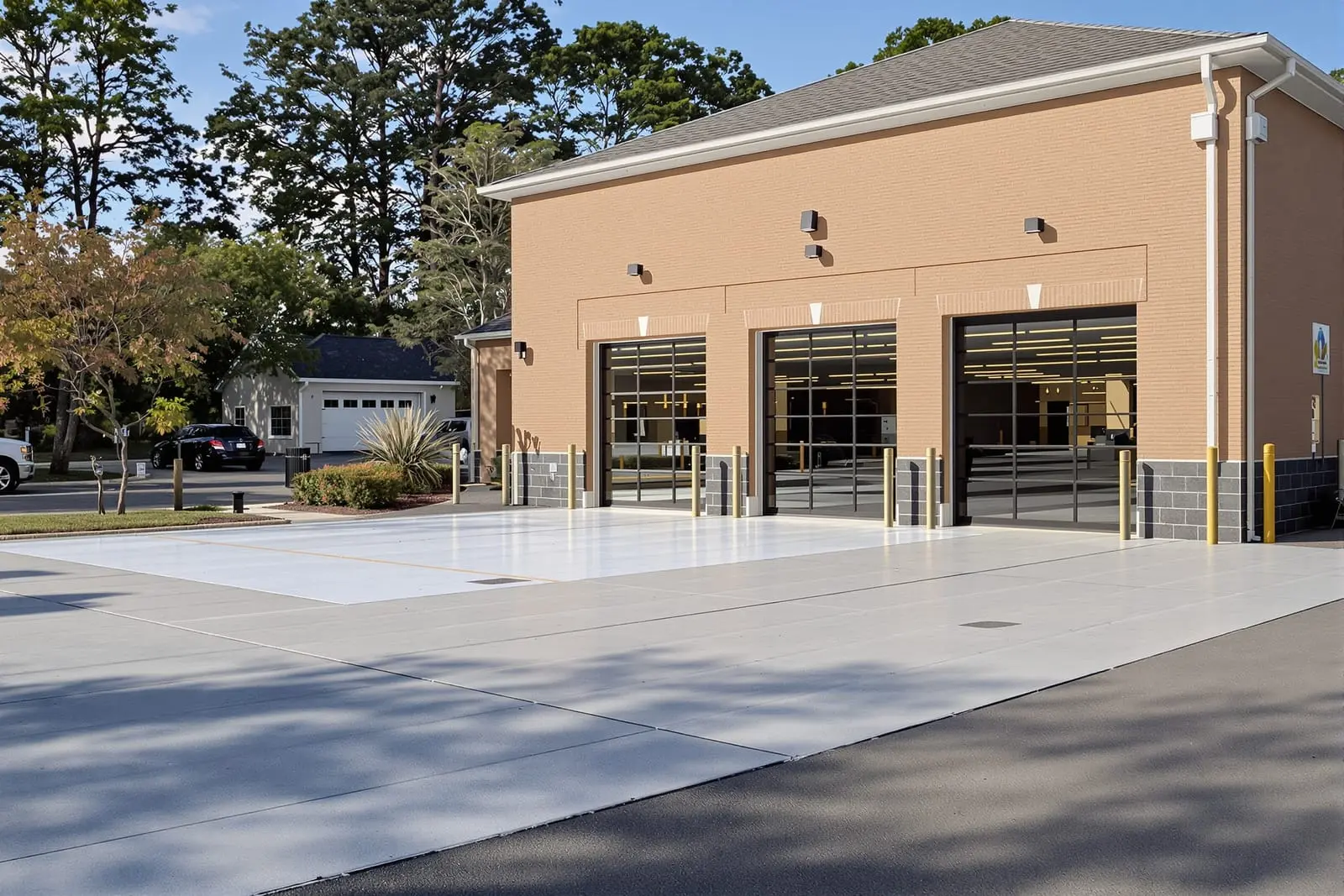
We build commercial concrete slabs in Little Rock, AR for loading docks, dumpster pads, and equipment areas. These heavy duty slabs are reinforced and thickened to handle truck traffic and point loads. Proper reinforcement and jointing help reduce damage over time. Contact us to design and install durable concrete around your loading operations.
Primetime Concrete Little Rock provides professional commercial concrete slab throughout Little Rock, AR and the surrounding area. Our licensed, insured crew delivers safe, clean, on-time work with a free estimate before anything begins. Call (501) 441-4583 or request your free quote.
Commercial Concrete Slab & Loading Dock Specialists in Little Rock
Primetime Concrete Little Rock builds commercial concrete slabs and loading docks that are designed for real world abuse: forklifts, semi trucks, pallet jacks, and constant traffic. We focus on structural performance first, then schedule and finish. Our crews are used to tight timelines, active facilities, and coordination with other trades.
A proper commercial concrete slab is very different from a basic residential driveway. Slab thickness, subgrade prep, joint layout, and reinforcement must match your specific loads and use patterns. A dock that takes 53 foot trailers all day will not be built the same way as a small delivery bay behind a retail strip. We start each project by asking about equipment weights, wheel loads, rack layouts, and traffic paths, then size the slab system accordingly.
We work across Little Rock and surrounding areas on warehouses, distribution centers, retail centers, light industrial shops, and municipal facilities. Whether you are adding a new truck dock, extending an existing loading area, or pouring a high flatness floor for racking, we plan the concrete from the soil up so it stays serviceable and safe for years.
How We Design a Commercial Concrete Slab That Actually Holds Up
A durable commercial concrete slab starts with the soil. In central Arkansas we see a mix of clayey soils that move with moisture and fill placed during past development. Primetime Concrete Little Rock begins with subgrade evaluation. We identify soft spots, organic material, and any areas with poor compaction. If needed, we bring in base rock, recompact, or work with your engineer to stabilize the base.
Next comes slab thickness and reinforcement. Typical light commercial work might use a 5 to 6 inch slab, while heavy forklift and loaded semi trailer areas can go 7 inches or more. Reinforcement might be welded wire fabric, deformed rebar on a grid, or in some cases, dowel baskets and thickened sections at dock face and rack legs. We discuss options with you and your design team so you understand what you are paying for and what risk you take if you cut thickness.
Concrete mix design is chosen for both strength and workability. Many Little Rock commercial jobs use 4000 psi concrete with air entrainment for freeze thaw resistance and crushed stone aggregate. For fast track projects, we can spec accelerated mixes so you can get back to operations sooner, but we will be blunt about cure times and when heavy loads are truly safe. Surface finish is matched to use: broom for outdoor truck areas, light or hard trowel for interior slabs, and specific flatness/levelness targets if you have high bay racking or narrow aisle forklifts.
Loading Docks Built for Trucks, Forklifts, and Safety
Loading docks concentrate huge loads into small areas. Trailer wheels, dock levelers, and concentrated forklift traffic all punish the same slab edges and surfaces every day. Primetime Concrete Little Rock treats dock areas as critical structural points, not just another pad poured at the back of the building.
We typically design dock approach slabs thicker than surrounding pavement and often with increased reinforcement at the dock face. Dowels tie the slab into the building foundation or dock wall so the two move together. At the door openings we often use embedded steel angles or edge protection to keep the concrete from spalling where dock levelers and dock plates slam down.
Drainage and slope are just as important as strength. We set dock slabs with enough slope away from the building so rainwater does not run back into your doors, while keeping transitions smooth enough for pallet jacks and forklifts. We can incorporate trench drains, area drains, or drip strips based on how water currently moves on your site. Surface texture around loading docks is usually a medium broom finish that balances traction in wet conditions with easy sweeping and snow removal when central Arkansas does see ice events.
We also coordinate with dock equipment installers. If you have mechanical or hydraulic dock levelers, we pour around their pits and embed anchor bolts and conduits per manufacturer specs. That way, once the concrete cures, your equipment can set in without cutting or patching your brand new slab.
What Affects Cost for Commercial Concrete Slabs and Docks
Every commercial concrete slab and loading dock in Little Rock has different cost drivers. Primetime Concrete Little Rock gives detailed line item estimates so you can see what is behind the number instead of a generic square foot price that might not fit your project.
Site access is a big factor. If ready mix trucks can back right up, we pour faster and need less labor. If concrete has to be pumped over other areas, moved around existing structures, or scheduled for nights and weekends to avoid shutting down operations, labor and pumping costs rise.
Soil conditions and thickness are the next major items. Poor subgrade that needs undercut and rock fill can add cost but saves you from slab failure later. Choosing a 7 inch slab with rebar instead of 5 inches with wire mesh is more concrete and steel now, but may be necessary if you run heavy lifts or dense pallet racks. We walk you through tradeoffs so reduced upfront cost does not become a maintenance problem in two or three years.
Finish requirements and jointing also play a role. High tolerance interior slabs for racked warehouses require more time, experienced finishers, and often laser screeds. Joint layout, dowel baskets, and proper sealants cost more during construction, but they reduce random cracking and long term trip hazards. Finally, schedule matters. If your slab must be poured in phases while you stay open, we plan mobilizations and cure times around your operations, which can slightly increase cost but keeps revenue flowing.
Local Codes, Permits, and Inspections in Little Rock
Commercial concrete slab and loading dock work in Little Rock often ties into building permits, drainage plans, and sometimes fire access requirements. Primetime Concrete Little Rock is familiar with local processes and coordinates with your general contractor, engineer, or directly with the city when needed.
For new builds inside Little Rock city limits or in North Little Rock, commercial slab and dock work typically falls under the main building permit with structural plans signed by a licensed engineer. We pour per those approved plans and accommodate any required inspections of reinforcement and base preparation before placement. If your project is a retrofit or expansion at an existing facility, some work may not trigger full structural review, but changes to drainage patterns and accessible routes still matter.
We pay close attention to door thresholds, slopes, and the interface between truck courts and accessible entrances so your loading improvements do not create code problems. If the slab ties into a fire lane or marked emergency access, we build to the required load ratings. For projects outside city limits, local county standards and utility easements still apply, especially where new concrete crosses or parallels water and sewer lines.
Before we start, we confirm who is responsible for permits, inspections, and engineering. Some clients bring stamped plans and only need a concrete subcontractor to execute. Others want us to connect them with local engineers who regularly design commercial concrete slabs and loading docks in this region. In either case you know what approvals are required before the first truck arrives.
Our Process and What You Can Expect From Primetime Concrete Little Rock
Primetime Concrete Little Rock keeps the process simple but detailed enough that you know what will happen on your job site. We begin with a site meeting to review traffic patterns, grades, and access. We ask specific questions: what are the heaviest loads, where do trucks queue, where do forklifts turn, and where do you want to expand in the future. Based on that, we propose slab thickness, reinforcement, expansion and control joint layout, and finish types.
Once scope is clear, we schedule around your operations. For active distribution centers, we often pour early mornings or in sections so some doors stay open. We mark out the work area, saw cut and remove existing pavement if needed, then excavate to the required depth. Subgrade is compacted and proof rolled so soft areas show up before concrete is placed.
Formwork and reinforcement come next. We set forms to correct elevations, install vapor barriers where required, and place rebar or wire per plan with proper chairs. Before concrete trucks arrive, we verify mix design and any admixtures such as accelerators or water reducers. During the pour we use screeds, bull floats, and trowel machines as appropriate, then cut or saw joints on a schedule that matches the slab thickness and weather so random cracking is reduced.
After placement, curing is critical. We may use curing compound, wet curing, or a combination depending on finish requirements. We do not rush you back onto the slab before it has reached safe strength for your loads. Finally, we walk the project with you to address any punch list items and discuss joint sealing, long term maintenance, and how to avoid damage from future saw cutting or equipment installations.
“
Professional loading docks & commercial slabs, done right the first time, quality materials, honest pricing, and results that last.
Primetime Concrete Little Rock
Loading Docks & Commercial Slabs Across Our Service Area